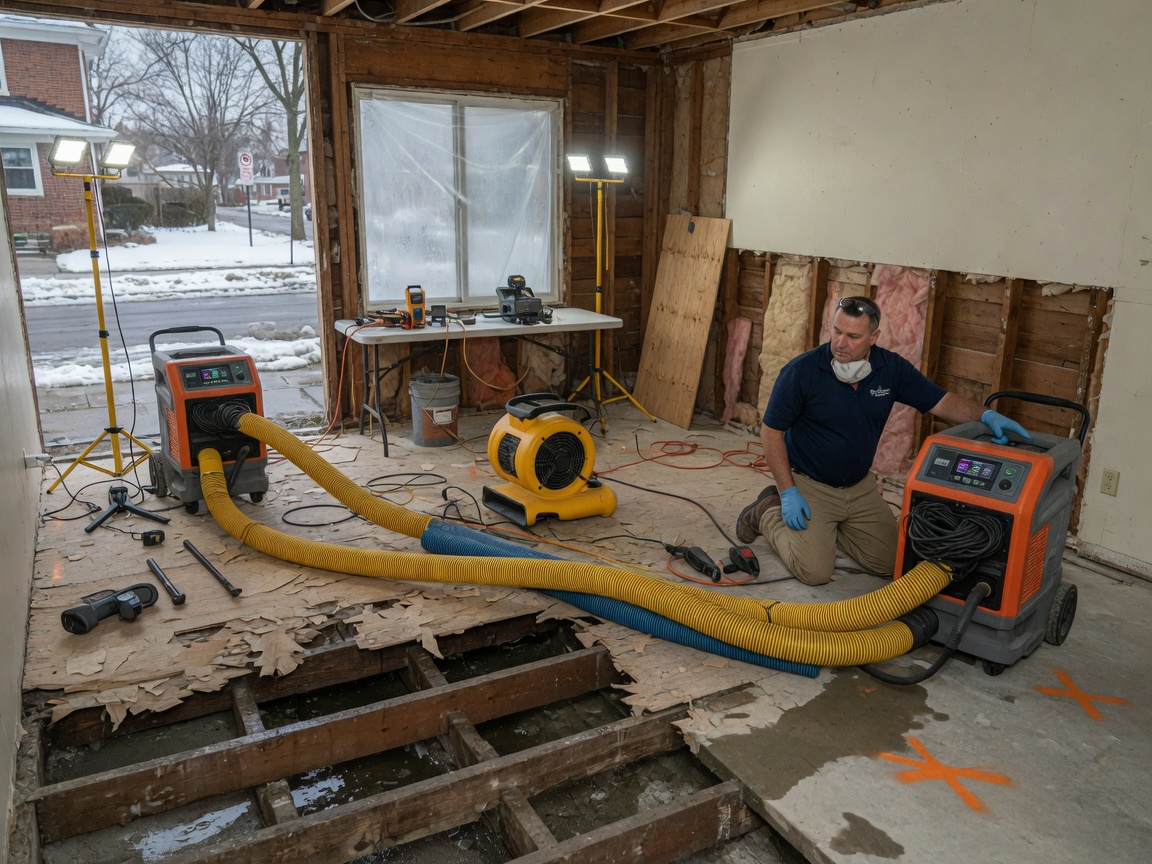
Rochester’s older housing stock in neighborhoods like Park Avenue and East Avenue often features brick and stone foundations with poured concrete slabs and dimensional lumber framing that trap moisture after spring snowmelt or heavy rains. In Monroe County’s humid continental climate, cold winters followed by rapid thaws push groundwater through porous materials, requiring industrial desiccant dehumidifiers and air movers placed directly against concrete to pull vapor from deep within the slab before mold colonies establish in the 48- to 72-hour window.
Framing members in pre-1950 homes around Charlotte and near High Falls frequently sit in direct contact with damp masonry, creating hidden rot pockets that standard fans miss. Technicians use moisture meters on joist ends and sill plates, then isolate affected bays with containment barriers so negative air pressure keeps spores from migrating into living spaces above. Subfloor plywood or hardwood in these properties swells and delaminates when left above 16 percent moisture content, so targeted drying under the floor is required before any finish work begins.
Nearby Pittsford and Irondequoit basements sit on clay-heavy soils that hold water longer, extending drying times compared with sandier pockets near the Rochester Public Market. Crews monitor relative humidity daily and adjust equipment placement because over-drying can crack aged plaster ceilings while under-drying leaves hidden moisture that reappears after the next lake-effect storm. All work stays within Mon–Fri 8am–6pm and Sat 9am–2pm from the 260 E Main St location so homeowners can plan access around school and work schedules.
Technician insight
In Rochester the thing that catches most people out with structural drying and dehumidification is how quickly clay soils around Park Avenue and Charlotte basements re-wet framing after a January thaw; if you stop equipment the moment the surface feels dry you’ll have hidden moisture in the sill plates that shows up as cupping floors the next spring.
East Avenue Brick Home After Spring Melt
Heavy snowmelt pushed water under the slab and into floor joists of a 1920s brick home near East Avenue. Meter readings showed 22 percent moisture in the subfloor and sill plates. Desiccant units ran for six days with daily checks until all readings dropped below 12 percent, allowing the homeowner to reinstall baseboards without future mold risk.
Structural Drying & Dehumidification (concrete, Framing, Subfloor) Services We Offer
✓Concrete Slab Drying
Industrial desiccant units pull trapped moisture from poured slabs common in Park Avenue and East Avenue homes before mold sets in behind baseboards.
✓Wood Framing Dehumidification
Targeted airflow and moisture monitoring dry sill plates and joist ends in older Monroe County framing to prevent rot after flood events.
✓Subfloor Moisture Extraction
Negative-pressure drying under plywood and hardwood floors removes hidden water in Rochester basements without full floor removal when caught early.
✓Insulation Cavity Drying
Removal and targeted drying of wet fiberglass or cellulose in wall cavities prevents hidden mold growth in Charlotte and Brighton properties.
✓Post-Thaw Structural Assessment
Meter readings on concrete, framing, and subfloor after winter snowmelt in Irondequoit and Pittsford identify areas needing extended equipment time.
Structural Drying & Dehumidification (concrete, Framing, Subfloor) Cost in Rochester, NY
| Service | Typical Range | What Affects It |
|---|---|---|
| Small basement slab and framing drying | $900–$1,600 | Single room, shallow saturation, 3–5 days |
| Full basement structural drying | $1,800–$3,200 | Multiple rooms, older wood framing, 5–8 days |
| Subfloor-only drying package | $650–$1,100 | Plywood or hardwood, access from above |
| Extended monitoring after initial dry-out | $250–$450 | Daily checks for 3 additional days |
Ranges are typical for Rochester, NY and confirmed with an exact written quote before any work starts.
How it works
- 1
Initial Moisture Mapping
Technicians use pin and pinless meters to chart moisture levels in concrete, framing, and subfloor across the affected Rochester basement.
- 2
Equipment Placement
Desiccant dehumidifiers, air movers, and containment barriers are positioned to create directed airflow without disturbing unaffected areas.
- 3
Daily Monitoring
Humidity and moisture readings are logged each day to adjust equipment until all materials reach safe drying thresholds.
- 4
Final Verification
Post-drying meter checks confirm concrete, framing, and subfloor levels before equipment removal and homeowner walkthrough.
Pricing
Cost depends on square footage, depth of saturation, and number of days required; upfront quotes provided after inspection.